Fair Doesn't Mean Identical

By Langdon Holmes, iTELL Chief Technology Officer
Picture two learners in the same iTELL course. Maria learned English as an adult, and she has never practiced writing short summaries that focus on the main concept, so she struggles to write an effective summary even though she has read the material carefully. Devon reads quickly and took a chemistry course last year. He skims the page, writes a confident summary and moves on.
Now give them the same passing score for their summaries. Maria fails, revises, fails again, and eventually becomes frustrated. Devon passes on his first try every time and never has to read closely. The fixed bar was supposed to treat them equally, but it fails both learners.
What we mean by fair
Fairness is often described as treating everyone the same. For a learning platform, I think that's the wrong target. Our learners arrive with different amounts of background knowledge, different reading speeds, and different levels of English. Treating them identically guarantees that the experience will be too hard for some of them and too easy for others.
The definition we work from is that every learner should have the same opportunity to learn from the material. Everyone is held to the same expectation, which is to read the text and show that they understood it. The support and the bar along the way adjust to the person.
The summary is for learning first
Every page in iTELL ends with a summary. Learners write, in their own words, what the page was about, and iTELL gives them feedback on what they wrote. It's tempting to think of this as a test. That isn't its main job.
Writing a summary is one of the most reliable ways to learn from a text. Psychologists call this the generation effect, the finding that information you produce yourself sticks better than information you passively read (Wesley wrote about it last month). When a summary misses part of the page, iTELL sends the learner back to the section they most likely skimmed, based on their reading time and what their summary covered. A chatbot then walks them through that section with questions, and they revise. Each pass through that loop is more learning.
The summary is also proof of work. A passing summary tells an instructor that the reading actually happened. That's its second job, and when the two jobs pull in different directions, learning wins.
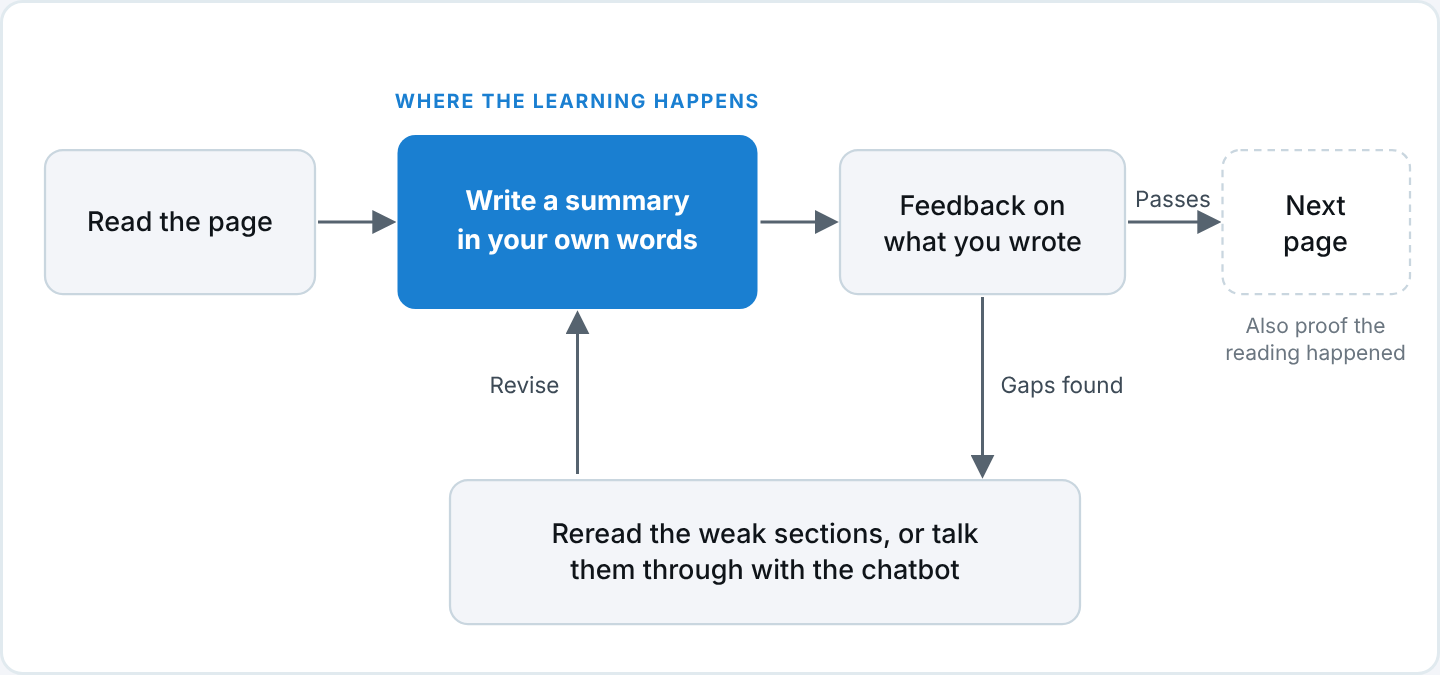
Writing the summary is where the learning happens. Passing it is also proof that the reading happened.
The same bar isn't the same chance
If the summary exists to make learners think, it should make every learner think. That rules out a single passing score. Set it high and less prepared learners get stuck. Set it low and strong readers coast through without engaging. Somewhere in the middle, you get both problems at once.
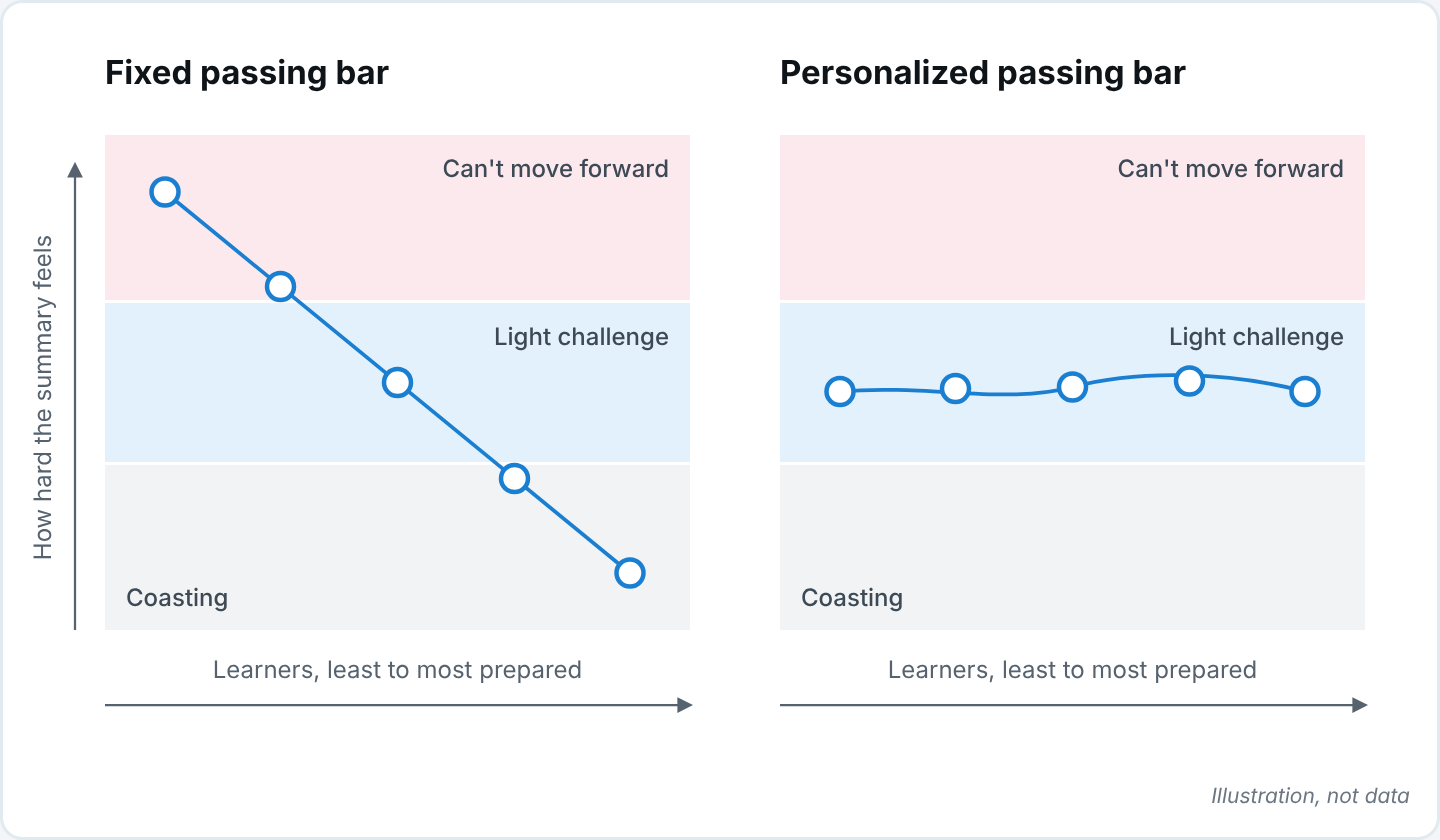
A fixed bar blocks some learners and lets others coast. A personalized bar keeps everyone in a light challenge.
So iTELL personalizes the passing bar. Each learner's threshold is estimated from their own summaries, informed by how others in their cohort are doing. Learners who pass easily see the bar rise. Learners who struggle see it ease. We aim for every learner to succeed on about 80% of their summaries, which keeps the task in a range we call a light challenge. It's hard enough to require real reading and achievable enough that nobody stalls out.
Two design choices keep this fair rather than arbitrary.
First, the bar moves slowly. Each summary nudges it by a small step, so no learner ever faces a wildly different standard from their classmates. Everyone starts from the same bar and stays close to the group.
Second, effort is never optional. An eased bar still requires a summary in the learner's own words that covers the page. iTELL screens summaries for language copied from the page and from the chatbot's replies, so the summary can't be outsourced. At the other end, learners who pass consistently build streaks that let them skip activities they don't need. That's a reward for demonstrated understanding, not a shortcut around it.
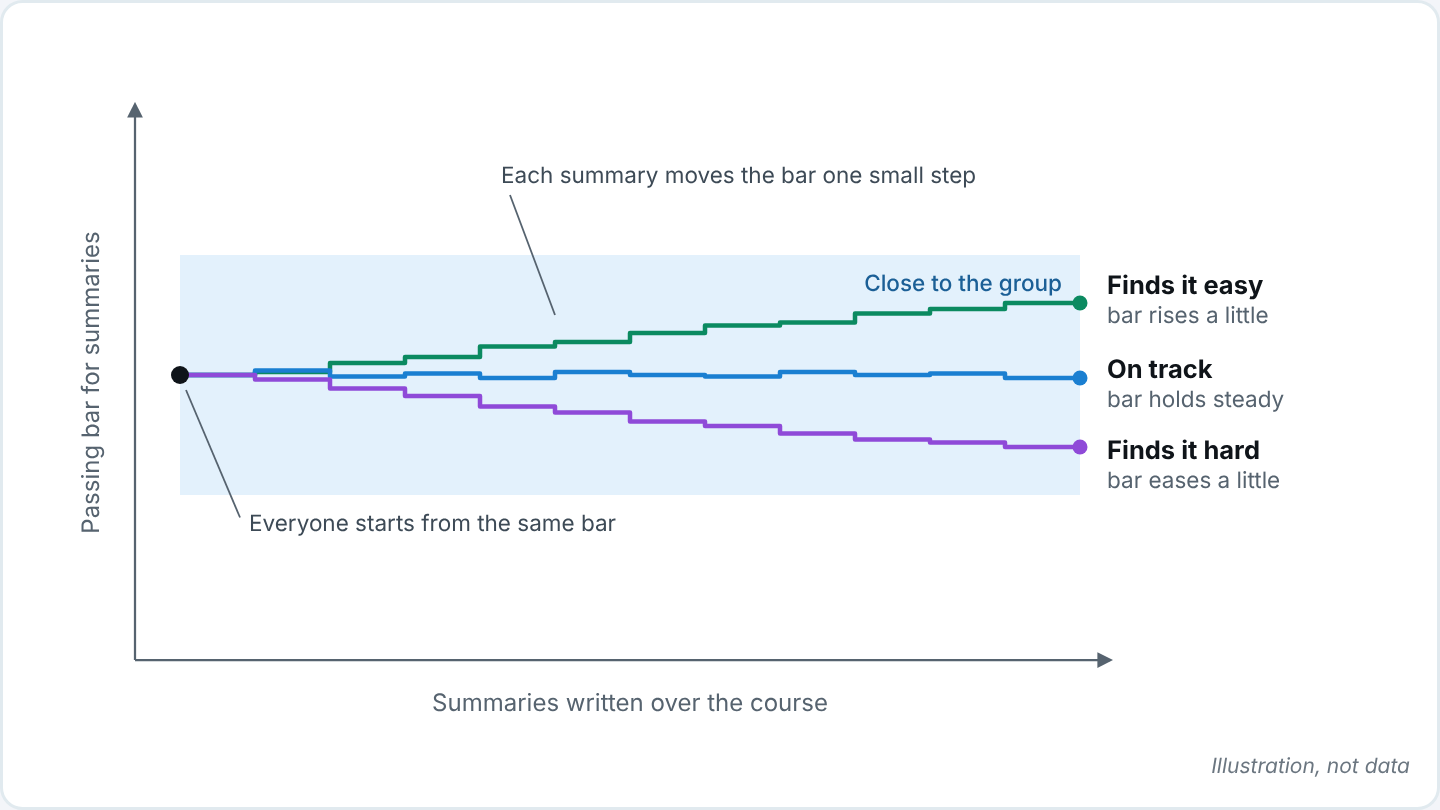
Every learner starts from the same bar. Each summary moves it one small step, so no one drifts far from the group.
Is it fair for two learners to clear different bars? For practice, I think it is. The certification exam at the end of a program doesn't adjust to the test taker, and it shouldn't. iTELL's job is to get every learner ready to meet that fixed standard. A practice activity that one learner can't pass and another can't fail doesn't prepare either of them.
Support that adapts to the learner
The passing bar is one lever. The rest of the platform is built around the same idea, that learners differ in predictable ways and each difference calls for a specific kind of support.
| Where learners differ | How iTELL responds |
|---|---|
| Background knowledge | A chatbot answers questions using the page the learner is reading (how it stays grounded). Short questions throughout the page come with feedback that explains what an answer missed. |
| Reading skill and speed | Rereading is targeted to the sections a learner most likely skimmed. Fluent readers earn their way past activities they've already mastered. |
| English ability | Scoring focuses on whether a response captures the content, not on grammar or spelling. Programs can generate a simplified version of dense source documents. |
| Time and device | Pages are broken into short sections, progress is saved as learners go, and everything works on a phone, so learners can study between shifts. |
| Disability and access | Interactive exercises work with screen readers and respect motion preferences (more on accessibility). |
We have early evidence that this kind of interaction helps the learners who need it most. When iTELL was used in an introductory computer science course, learning gains were larger for lower-proficiency students (Crossley et al., 2024). In a randomized controlled trial with more than 350 online participants, readers who spent more time on the text scored higher on quizzes when they used the interactive version of iTELL. In the static and no-feedback versions, slower readers scored lower (Crossley et al., 2025). Slower readers may be less proficient or simply more careful, and that study can't tell which. Collectively, our research shows that iTELL supports struggling learners in ways that static reading does not do.
Scoring understanding, not language
iTELL's scoring models are trained to focus on what a response says, and we expand their training data with varied writing styles and formatting so that how something is written matters less. Before we train a scoring model, we take the training data and inject spelling and grammatical mistakes into the responses without changing the score. This forces the model to learn that a response should get the same score with and without language errors, which means the scores measure what the learner knows, not how well they conform to writing conventions.
Fairness is a design decision
Fairness isn't a feature we added at the end. It's a decision we make at every layer of the platform, including what the summary is for, where the bar sits, what the scorer pays attention to and what support a learner gets when they're stuck.
If you're evaluating AI tools for your program, ask every vendor, including us, what happens to the learner who reads slowly, writes in their second language or studies on a phone between shifts. The answer will tell you a lot about who the tool was built for.
References
Crossley, S. A., Choi, J. S., Morris, W., Holmes, L., Joyner, D., & Gupta, V. (2024). Using intelligent texts in a computer science classroom: Findings from an iTELL deployment. Proceedings of the 8th Educational Data Mining in Computer Science Education Workshop (CSEDM 2024). https://ceur-ws.org/Vol-3796/CSEDM-24_paper_8293.pdf
Crossley, S., Choi, J. S., Morris, W., & Holmes, L. (2025). Exploratory assessment of learning in an intelligent text framework: iTELL RCT. Proceedings of the Twelfth ACM Conference on Learning @ Scale (L@S '25). https://doi.org/10.1145/3698205.3729548