iTELL You What's Broken About eLearning (And What Actually Fixes It)

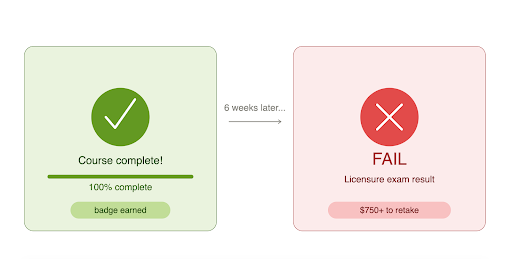
Picture this: your employee just completed their certification training. They clicked through every slide, answered the end-of-module quiz (on the third attempt), and got their little digital badge. Six weeks later, they fail the licensure exam. You're now looking at $750 (or sometimes more) in retraining costs, a 45-day wait before they can retest, and a role that still isn't filled.
Somewhere, an eLearning authoring tool is not sorry.
This is the quiet crisis sitting inside workforce training programs across the US. And if you're a program manager responsible for getting people certified, licensed, and field-ready, you already know exactly what I'm talking about. You've watched it happen. You've signed off on the retest paperwork. You've explained to leadership why the onboarding timeline slipped again.
The problem isn't your people. The problem is the tools.
The eLearning industry has a comprehension problem
25% of US jobs require licensure or certification before work begins. That's a quarter of the workforce that needs to genuinely understand and retain material, not just click through it.
Yet the dominant training model hasn't changed in twenty years: take a document, turn it into slides, add a quiz, mark the learner complete.
Except complete and ready are not the same thing.
Learning science has known since 1885 that people forget roughly 70% of passively consumed information within 24 hours. Traditional authoring tools like Articulate or iSpring give you beautiful production value on top of a fundamentally passive experience. They help you build the slide deck faster. They don't fix the comprehension problem.
What actually builds exam-ready understanding
Active recall. Self-explanation. Adaptive feedback. The research on what builds real retention isn't new. But what's been missing is a tool that operationalizes it at scale, without rebuilding your content library from scratch.
That's iTELL.
Here's how it works:
- Upload your existing training materials: manuals, SOPs, regulatory guides, certification prep docs
- Create: iTELL's AI converts them into interactive modules with self-explanations, short-answer prompts, and gap-fills in minutes
- Review: your experts validate outputs for accuracy and compliance
- Train: learners engage actively through AI-guided conversations and applied tasks
- Monitor: managers track comprehension gaps in real time, before exam day
That last point is the one that changes the math. The costly failure in licensure training isn't that people don't try — it's that nobody finds out they didn't understand something until they're sitting in an exam room. This is an issue we've heard on repeat, specifically within the K-12 teaching licensure space, where pass rates in certain subjects are abysmal.
iTELL moves that discovery earlier, when you can still do something about it.
Why I'm building this
I'm not a learning scientist. I came to iTELL through Vanderbilt's Entrepreneurship through Tech Transfer program, with a background in building things at early-stage companies: a women-only ride-hailing startup in Pakistan, an EdTech platform across South Asia, content and growth work at B2B SaaS companies. I know what it looks like when a market is ready for a real solution and the incumbent tools are coasting.
The eLearning authoring space is coasting.
What pulled me in wasn't a single dramatic moment. It was the combination of two things you don't often find together: a team that is genuinely exceptional, and a product that is genuinely differentiated. The iTELL research isn't marketing copy — it's eight peer-reviewed publications showing measurable learning gains over traditional digital text. The founding team has spent careers in learning science. They didn't build iTELL because AI was trending. They built it because they had spent years understanding exactly why existing tools fail, and exactly what the science says should replace them.
When you find people like that, attached to a problem this large, you don't overthink it. You get to work.
The bottom line for program managers: fewer failed first attempts means lower retraining costs, faster deployment, and fewer Monday morning conversations about why the cohort isn't ready yet.
That's what we're building. Come see it in action.